

By Julie Carlier
Every large festival, city celebration, sporting event, or mass protest has them: crowds. Young and old, religious and non-religious, participating for the sport, music, or simply the atmosphere. Recent research by Gu, et al. (2025) offers new quantitative and physiological insights into the movements within high-density crowds. In this article, we discuss these new findings and explore to what extent they can be explained through sociological theories about crowds. What do these insights mean for crowd management at mass events?
A Quantitative Approach to Crowds
In the article “Emergence of Collective Oscillations in Massive Human Crowds”, Gu et al. (2025) take a quantitative approach to understanding large crowds. They argue that the dynamics of dense crowds in confined spaces can lead to highly dangerous situations, such as crowd crushing. Previously, scientific studies often used heuristic models focusing on the interactions of small groups of individuals, without examining how these crowds actually move. In their paper, Gu, et al. (2025) present a mechanical quantitative theory based on observations and footage from the San Fermin Festival in Pamplona and the Love Parade in Duisburg.
Their analysis revealed that crowds do not move linearly in relation to one another. Instead, they exhibit what the researchers term ‘chiral oscillators’: asymmetric, rotating movements that can turn either left or right. These spontaneous movements were observed in thousands of individuals, occurring without any external stimuli such as a leader or a starting signal. The goal of this study was to develop a strategy for detecting and anticipating movement dynamics in high-density crowds.
Rotating Patterns
The study concludes that pedestrian flows in dense crowds are not chaotic but instead exhibit periodic, chiral (rotational) behaviour in certain areas. The research shows that once peak crowd density is reached, oscillations emerge that last approximately 18 seconds. The transition from linear movement to rotational oscillation is clearly visible and therefore potentially preventable. These rotational movements can result in so-called ‘crowd quakes’. These are periodic moments during which the crowd density becomes so extreme that individuals are involuntarily pushed in a particular direction. This causes people to press up against each other, increasing the risk of falling. The pressure waves move through the crowd like water ripples, and such movements have, in several instances, resulted in injuries and even fatalities.
Through a Sociological Lens
While Gu, et al. (2025) explore the physiological aspects of crowd movement at events such as festivals or concerts, they do not explain why people behave this way. Therefore, we shed light on various sociological theories explaining the dynamics of crowds and providing possible explanations for the emergence of oscillations.
We begin with Le Bon’s Contagion Theory (1891), which suggests that individuals lose their sense of autonomy when they become part of a group. As a result, they tend to exhibit impulsive and uninhibited behaviour (Savage, 2021). The behaviour of one individual in a crowd can spread amongst others, like a contagion. Individuals lose rational thought and self-reflection, as if absorbed by the crowd. From this perspective, people in dense crowds may impulsively follow the movement of the group without having a fully rational reason. They simply go where the crowd goes.
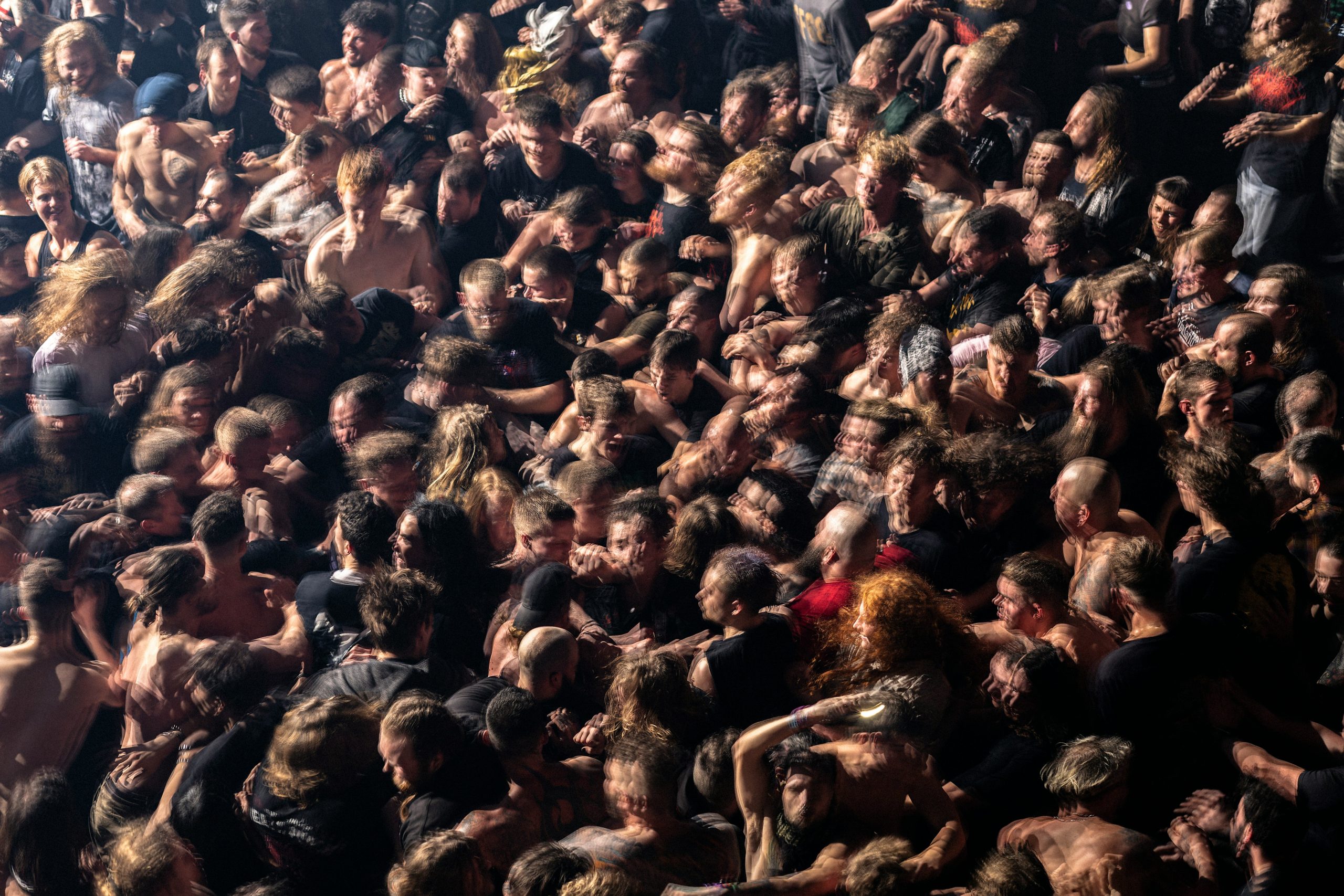
A related concept is Herding Behaviour Theory by Raafat et al. (2009). The oscillations that emerge in crowds may result from herd behaviour. This phenomenon explains the human tendency to mimic the actions of others, without being consciously directed to do so. People’s frame of reference can be shaped by the stories, recommendations, or beliefs of others. This mirroring can lead to cohesive behaviour within the group, where individuals allow themselves to be guided by others (Kameda & Hastie, 2015). In high-density settings, individuals are unlikely to make decisions that deviate from those of the group.
In this context, it is also useful to distinguish actual crowd density and participants’ perception of safety. Daniel Stokols (1972) made a distinction between objective density and subjective crowding. Objective density measures the number of people per square meter and subjective crowding focuses on how that density is experienced by individuals. The latter can depend on individual traits, cultural context, spatial characteristics, and social relationships. For example, participants at the San Fermin Festival may not have reported feeling unsafe, despite objectively high density. They most likely felt connected to the crowd and the event, making their subjective sense of crowding lower than the measured density.
The Social Identity Theory (Tajfel & Turner, 1979) also explains the difference between objective and subjective safety in a crowd. According to this theory, people adjust their behaviour, norms, and values to align with the social group they identify with. This creates a strong sense of connection, and therefore empowers the so called ‘us versus them’ thinking. This phenomenon was observed in John Drury’s research on the Hajj, an annual religious pilgrimage to Mecca that draws an average of 2.5 million people. Each year, hundreds of pilgrims die due to heat or crushing. Drury found that during the Hajj, participants feel safer because of a strong shared social identity. They also expect help from others around them (Alnabulsi et al., 2018). This indicates that perceived safety can be much higher than the objective safety conditions.
We follow the crowd
The sociological theories help us understand the emergence of large crowds and their behaviour. These theories suggest that individuals are either unconsciously guided by the crowd or consciously choose to follow it, often without making fully autonomous decisions. The theories differ in how they explain this. Le Bon and Raafat emphasize the suppression of individuals’ will and identity, while Stokols and Drury focus on the social-psychological context: people follow the crowd because they identify with it, trust those around them, and expect mutual support. Of course, physical forces within a crowd could also play a role. If the collective force shifts to the left, it becomes nearly impossible for an individual to move to the right. People still think for themselves but make decisions that account for their limited physical options. They may follow the crowd that seems safest or most familiar, hoping it leads them toward the desired outcome. These factors help explain why oscillations occur within crowds.
Applying Insights to Crowd Management
Gu, et al. (2025) offer a scientific model for explaining the physiological movement of large crowds. Sociological theories have long been applied to mass gatherings, especially regarding how individual behaviour changes within a crowd. Combining physiological and sociological perspectives could contribute to safer crowd dynamics at large events.
What Can We Do?
As mentioned earlier, oscillations can lead to ‘crowd quakes’. These wave movements have a significant impact on the safety of people in the crowd. Through three measures, this risk can possibly be reduced. Firstly, when an event organizer and other relevant services are aware of the collective behaviour or shared identity of the crowd, the way of communication can be adapted to this specific group and thereby result in a greater reach. Secondly, the monitoring and detection of oscillations can contribute to early intervention in the movement of the crowd. Because the research by Gu, et al. (2025) provides tools to recognize and measure risky oscillations, staff in camera surveillance or security may be able to observe this more effectively and in an earlier stage. It is important, however, that staff are well trained in detecting these oscillations and in assessing the crowd density. As a final measure, the design of the event space can contribute to the prevention of oscillations, for example by managing the maximum safe capacity of a location, providing sufficiently wide walking routes, avoiding opposing flows where possible, and clearly indicating desired walking directions.
Of course, these measures do not offer a guarantee of success, but hopefully the new insight by Gu, et al. (2025) provides more tools to manage the safety of crowds at events and other crowded places.