
By Jochem den Nijs
Simulation technology allows us to test situations which do not exist (yet), which are expensive to test in real life or where testing normally would create dangerous situations. Pedestrian simulation enables the modelling of crowds at events and other busy environments. What can we achieve with these simulations, when can they be used to add value and what are the pitfalls of crowd simulation?
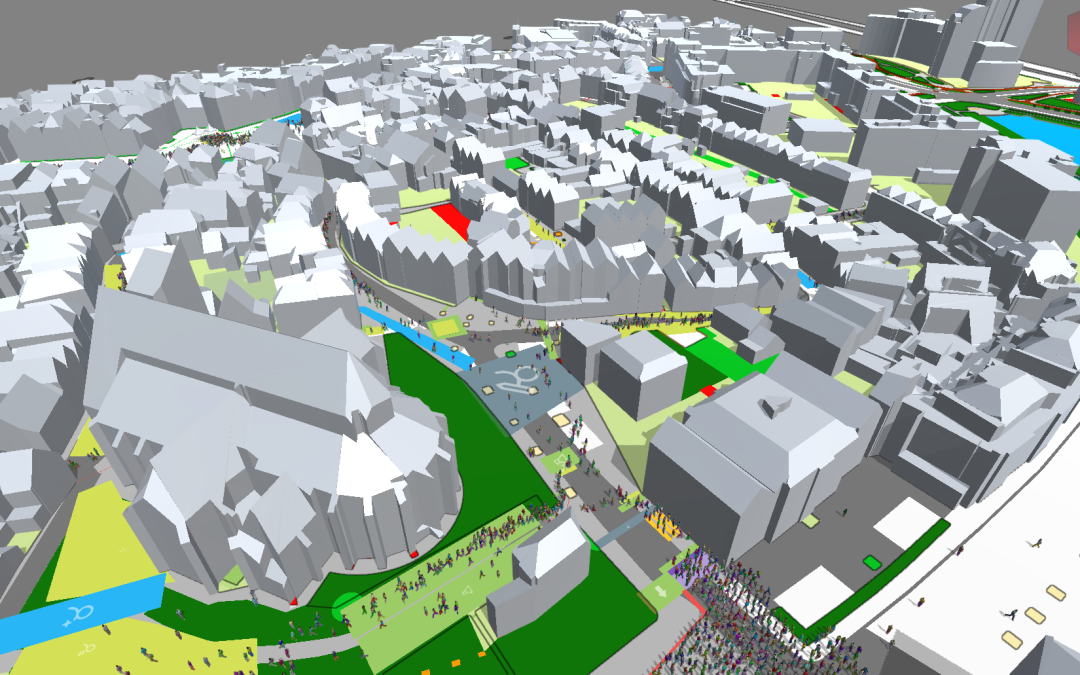
Crowd simulations simulate thousands of pedestrians (agents in technical terminology) in a virtual environment. Each agent gets simple rules to dictate their behaviour. Research has shown that these simple rules can emulate complex crowd behaviour like collision avoidance and lane formation within moving crowds.
Testing using Simulations
Because certain complex behaviours can be modelled reliably using simulation models, they can be used to identify crowd flows and bottlenecks. In addition, evacuations can be tested for different situations. Simulations capture the interaction between pedestrian flows and individual route choices. Additionally, they offer the option to test non-existent locations of alternative scenarios. This could be the new design of a stadium, an event in the urban environment or the consequences of a crowd management measure like closing a route.
For events simulations have been used successfully in the past. A famous example is the Jamarat Bridge in Mecca where dangerous crowding conditions caused deaths during the yearly Hajj. Crowd simulation played an important role in improving crowd safety so significantly less (deathly) accidents occur. Simulations could also be used to optimise the evacuation times and in international football, crowd simulations are frequently used for major matches to test the visitor flows on the premises.
Not a Crystal Ball
Pedestrian simulation is thus a strong tool to improve analyses even further. But a crowd simulation cannot predict the future. Because simulated crowd behaviour is constructed using simple rules, the results from the simulation will never be perfectly aligned with reality. All people in the simulation (agents) follow the same rules, making it impossible to capture individual human behaviour.
But some crowd behaviour is currently not possible to recreate due to the rules not being optimised for it. A recent study shows the limitations of crowd simulations for large-scale events, where they struggle with large surface areas with a large number of people.
Select the Correct Tool
When using pedestrian simulation tools, care should be taken to ensure the simulation software aligns with the question which is being addressed. Simulation models should be interpreted critically, but this should not overshadow the situations in which these models perform well. At ESI, simulations are primarily used to analyse events and other large gatherings.
Overall, crowd simulation provides a data-driven way to better understand pedestrian movement at events and other large gatherings. While it is important to remain aware of its limitations, the technique offers valuable insights that are difficult to obtain through other analyses.
Continuous development is done on the simulation methods. The simulations offer a good method to analyse and optimise flows, moreover they can be used to test locations which do not exist (yet). Are you already interested in how crowd simulation could improve the crowd safety at your events or large-scale crowds?