
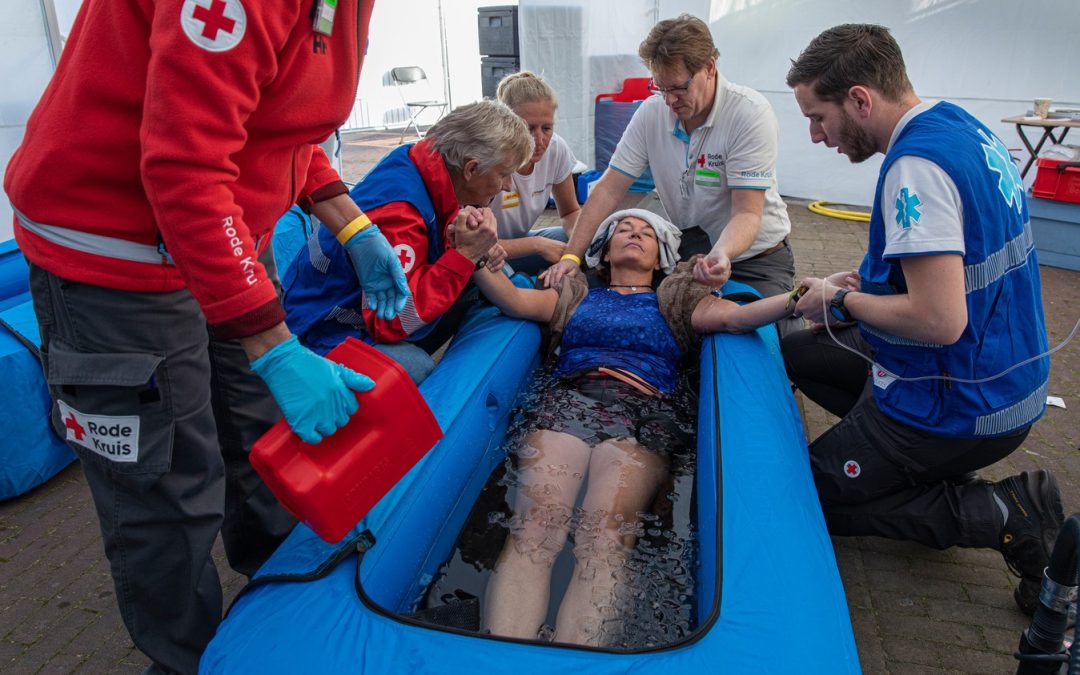
Exertional heat stroke is a life-threatening medical emergency. Scientific evidence is clear: rapid, aggressive cooling can save lives and reduce the risk of serious complications. Yet effective cooling facilities are still not standard practice at running events worldwide. Countries including the Netherlands, Canada, the United States and the United Kingdom have made important progress. It is time to turn the scientific evidence into standard practice internationally.
A growing challenge for running events
Running events are more popular than ever. Marathons, half marathons, trail races and other endurance events attract millions of participants worldwide. With this growth comes an increasing responsibility to prepare for exercise-related heat illness. One of the most dangerous conditions is exertional heat stroke (EHS). It occurs when intense physical activity causes a dangerous rise in core body temperature, typically above 40°C (104°F), accompanied by neurological symptoms such as confusion, disorientation, seizures or loss of consciousness.
EHS is a medical emergency. Without immediate treatment, it can cause severe organ damage or death. Yet medical provision at many running events still focuses mainly on water stations, wet sponges, shade and first aid facilities. These measures are important for prevention, but they are not sufficient when a runner develops heat stroke.
At that point, immediate and aggressive cooling is essential.
The scientific evidence: cold water immersion works
There is substantial scientific evidence that cold water immersion (CWI), involving the immersion of the patient’s body in cold or ice water, is one of the most effective treatments for exertional heat stroke. Water transfers heat much more efficiently than air, allowing core body temperature to fall rapidly. Three important publications demonstrate why this approach matters.
1. Systematic review: effective and rapid cooling
Douma and colleagues published First aid cooling techniques for heat stroke and exertional hyperthermia: A systematic review and meta-analysis in 2020. The researchers analysed 63 studies and found that immersion in water between 1°C and 17°C was more effective at reducing core temperature than passive cooling methods. The findings provide strong support for making cold-water immersion facilities available at endurance sports events.
2. Cooling speed can determine survival
Another important study, Exertional Heat Stroke, Modality Cooling Rate, and Survival Outcomes: A Systematic Review (2020), analysed 521 patients. The results were striking:
- No deaths were reported among patients who received cooling at a rate above 0.15°C per minute (0.27°F per minute).
- Twenty-three deaths were reported among patients who received insufficiently rapid cooling.
- Medical complications were considerably more common in the latter group.
Although this was a review of published case reports rather than a randomised trial, the findings strongly support the importance of rapid cooling.
The speed of cooling matters.
3. International guidelines support immediate cooling
The International Olympic Committee (IOC) recommends early recognition, rapid diagnosis and immediate on-site cooling for exertional heat stroke. Its 2021 publication, Prehospital management of exertional heat stroke at sports competitions, specifically recommends whole-body cold water immersion. Cooling should continue until rectal temperature falls below 39°C ((102.2°F). Rectal temperature measurement is essential for accurately assessing core temperature. The IOC also promotes a simple but powerful principle:
Cool first, transport second.
In other words, do not delay effective cooling while waiting for hospital transport. Start treatment at the event venue. The IOC’s 2023 consensus statement reinforces the need for trained medical teams, appropriate equipment and rapid cooling facilities.
What does effective cooling look like in practice?
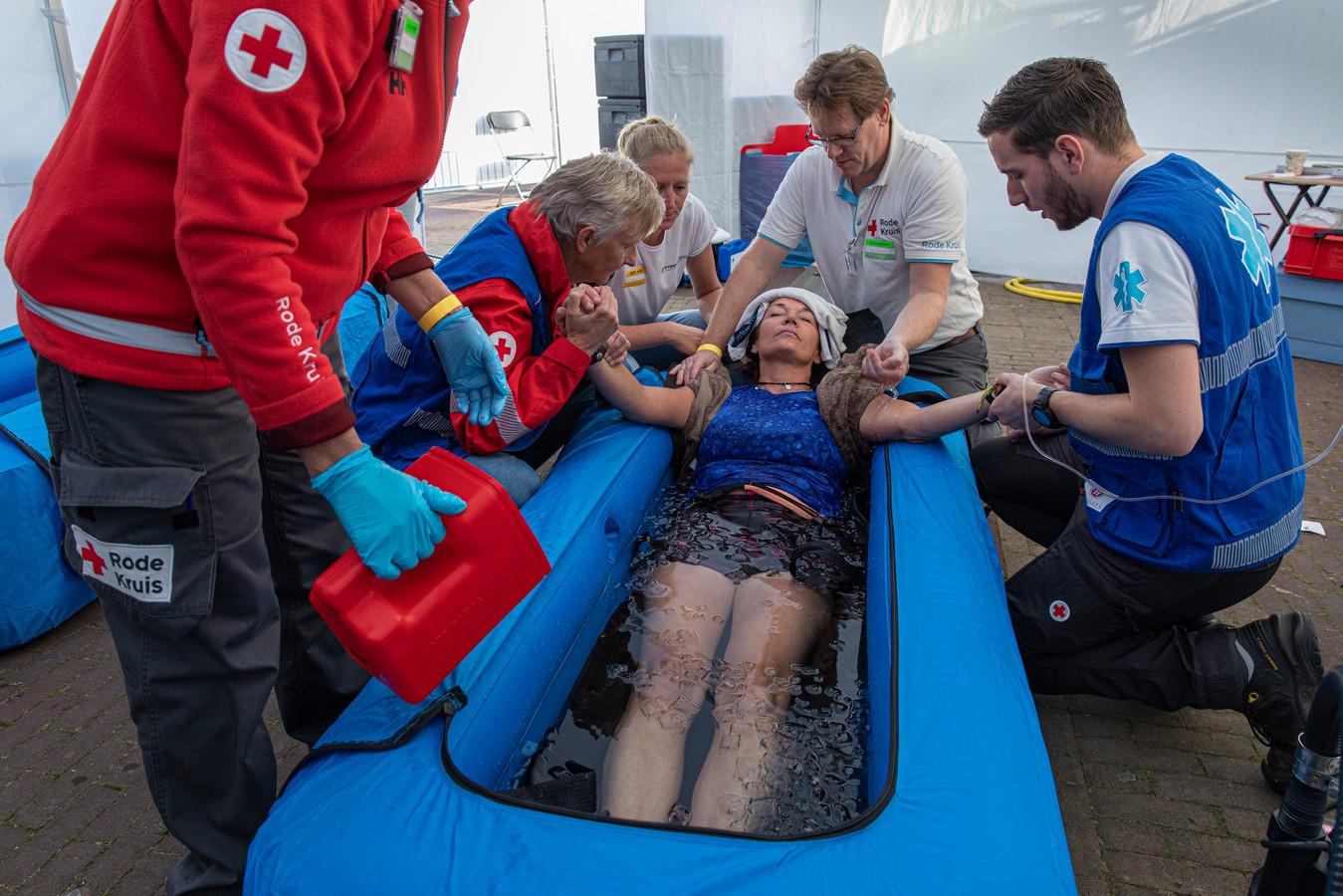
The availability of an ice bath alone is not enough. Organisers need a properly prepared medical cooling facility.
The IOC recommends:
- A suitable immersion tub, prepared before the event.
- Sufficient water and ice, with water temperatures generally around 5–15°C (41-59°F).
- Trained medical personnel with clearly assigned responsibilities.
- Reliable rectal temperature measurement.
- Continuous monitoring throughout treatment.
- Clear procedures for subsequent medical assessment and hospital transfer.
The IOC describes four medical roles per patient: maintaining the airway and patient safety, monitoring core temperature, managing the cooling bath and documenting treatment. For incidents occurring away from the medical station, tarp-assisted cooling can provide an alternative. This involves using a waterproof tarp, ice and water to create a temporary immersion-like cooling environment.
The key is to start effective cooling as quickly as possible.
Text continues below the image.
International progress: examples from four countries
Aggressive cooling is not yet consistently implemented at running events worldwide. However, several countries have translated the scientific evidence into practical guidelines and event medical procedures.
The Netherlands
The Dutch Veldnorm Evenementenzorg (Field Guide to Event Care) introduced specific guidance for endurance sports and running events in 2023. It includes procedures for cooling with ice-water-soaked towels and whole-body immersion in cold or ice water.
There is also practical experience at major Dutch running events, including the Dam tot Damloop. A published study involving 94,033 race starters at this Dutch running event documented the use of cold-water immersion facilities. Four cooling tubs were installed at two locations, including the finish area, with water temperatures maintained between 10°C and 15°C.
Canada
Health Canada’s Extreme Heat Events Guidelines: Technical Guide for Health Care Workers explicitly recognises ice-water immersion as an effective treatment for exertional heat stroke. The guidance recommends that ice-water baths be considered as part of first-aid planning at athletic events, including marathons and football matches. It also emphasises the importance of rapid cooling and monitoring core temperature.
The United States
The American College of Sports Medicine’s (ACSM) Consensus Statement on Exertional Heat Illnes recommends that athletic venues where exertional heat stroke is a realistic possibility have the equipment and trained personnel needed for whole-body cooling.
Cold-water immersion is identified as the preferred field-based cooling method. This approach is particularly well established in American collegiate sports medicine, including football, where emergency cooling facilities form an important part of heat illness preparedness.
The United Kingdom
The United Kingdom is also making progress with cooling techniques. England Athletics has issued recommendations for running events in hot weather. These include ensuring adequate supplies of ice, buckets and towels in medical areas, carrying ice and water with mobile medical teams, and using rectal temperature measurements to identify serious heat illness.
The London Marathon provides an example of the importance of a well-organised medical response. St John Ambulance has documented the treatment of a runner who developed severe heat stroke during the event, with a core temperature of 41°C. The medical team rapidly initiated cooling using ice and cooling blankets, helping save the runner’s life.
At the Brighton Marathon in 2023, medical teams went a step further by implementing a dedicated cold-water immersion system. A runner with heat stroke was treated using this method and recovered without hospital admission.
These examples demonstrate both the importance of rapid cooling and the practical potential of cold-water immersion at mass-participation events.
Beyond water and sponges
The scientific evidence is compelling, and practical examples from several countries demonstrate that aggressive cooling can be successfully incorporated into event medical services. Nevertheless, there remains a gap between medical recommendations and their implementation at running events.
Water stations, wet sponges, shade and hydration advice remain essential preventive measures. But they should never be confused with the treatment of an actual heat stroke.
Event organisers should consider:
- Dedicated medical cooling facilities with suitable immersion tubs.
- Sufficient supplies of water and ice.
- Medical personnel trained to recognise and treat exertional heat stroke.
- Reliable equipment for measuring core body temperature.
- Clear emergency procedures and arrangements for hospital transfer.
- Cooling options along the course as well as at the finish area.
Importantly, this preparation should not be restricted to events taking place during heatwaves. Exertional heat stroke can also occur at more moderate ambient temperatures.
Time to make aggressive cooling standard practice
The scientific evidence is clear. Systematic reviews, international consensus statements and national medical guidelines all support rapid, aggressive cooling as an essential treatment for exertional heat stroke.
The examples from The Netherlands, Canada, the United States and the United Kingdom demonstrate that the necessary knowledge, protocols and practical experience are already available. The next step is to ensure that these measures become standard practice at mass-participation running events worldwide.
Event organisers should do more than provide water and sponges. They must be prepared to treat the runner who develops a life-threatening heat stroke.
This means investing in appropriate equipment, training medical personnel and incorporating aggressive cooling into the emergency medical plan of every event where exertional heat stroke is a realistic risk. It is not about putting every runner in an ice bath. It is about ensuring that the right equipment and expertise are available when they are needed most.
Cool first. Transport second. Save lives.