
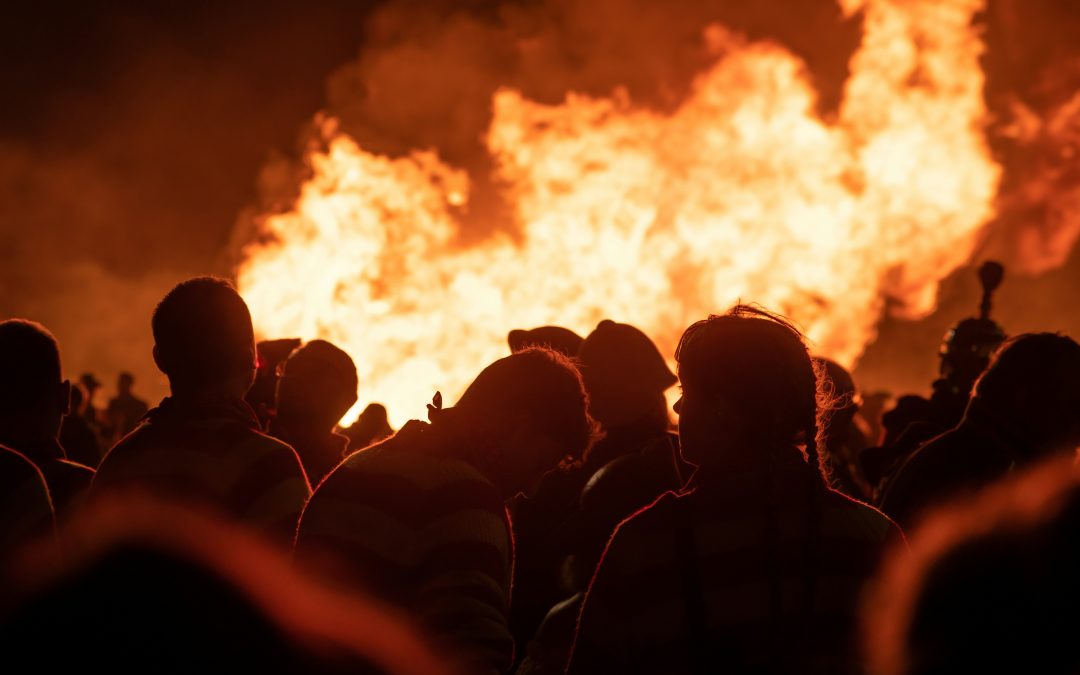
The Crowds, Psychology, Policy, and Practice (CP3) conference, which took place on 27 and 28 August 2026 at the University of St Andrews in Scotland, was unique in its set-up and in the richness and high level of its discussions. After sharing some of the outcomes concerning contentious crowds in a recent blog, we now present some of the findings regarding the study of crowd behaviour in emergencies.
Crowd psychologists have been studying crowd behaviour in events such as plane crashes, floods, bombings, and other disasters for quite some time. What we know, for example, is that during an emergency or disaster, panic and egoistic behaviour (‘everyone for themselves’) are rare. In fact, the opposite is often true: people who may not have known each other before form groups, display effective and supportive behaviour, and even risk their lives for complete strangers with whom they identify because they are all facing the same situation. In disasters, resilience is often built collectively.
What is less well understood is how inequality within societies affects collective behaviour and people’s willingness to support others. Examples mentioned in this context included the caste system in India.
Dealing with cascading and recurring disasters
During the CP3 conference, discussions focused on new developments in disasters resulting from climate change, such as cascading and recurring events. An example of a cascading event would be a flood leading to buildings collapsing, groups of people being cut off from food and medicine, and the spread of disease. Recurring events may include severe storms occurring repeatedly or earthquakes striking the same region again and again.
Delegates at the conference agreed that more research is needed into the cumulative effects of these types of events on crowd behaviour. The effects of poor management of disasters were also mentioned. With limited information and limited resources, the management of events such as natural disasters can quickly lead to foreseeable social dilemmas: who should be helped first, how should different groups be prioritised, and how should economic interests be balanced against humanitarian needs?
Disasters may therefore have long-lasting effects on social structures and processes within communities. One question raised, which requires further research, is whether the increasingly foreseeable rise in the intensity of natural disasters may have negative effects on solidarity and mutual support.
What is resilience?
Another popular subject that can be directly linked to dealing with disasters is empowering people to become more resilient. This is currently high on the political agenda in many countries, and there are many initiatives aimed at strengthening civil resilience. In Europe, this is not only in response to natural disasters; the threat of war appears to be an increasingly important driver as well.
Scientists and practitioners at the CP3 conference agreed that we need to move beyond the political approach to resilience and adopt a more instrumental approach: who needs help, and why? We also need to know more about the effects of informing and training the public.
Social identification in disasters
During the conference, there was some discussion about the relationship between experiencing an emergency or disaster as a group and the creation of a shared social identity. For example, people may have different reasons for disregarding government instructions. There was some agreement that limited resources can lead to unequal responses.
A paper by Sara Vestergren et al. was mentioned that examines whether emergencies can trigger protests, which may be an effect of unequal treatment. It would be useful to learn more about patterns such as these and about the conditions that trigger free-riding, with a particular focus on the realities of today.
Doing so could help us better understand the conditions and mediating factors that lead to different outcomes in terms of social identification during emergencies. This, in turn, can help authorities and emergency planners develop strategies that take social identification into account, empower people, and strengthen community resilience.