
Thirty years ago, British band Oasis played the biggest concerts of their career on 10 and 11 August 1996. Over one weekend, the hugely popular band performed to 250,000 people at the grounds of Knebworth House in Hertfordshire. The documentary ‘Oasis Knebworth 1996’ offers a fascinating insight into the strong social identity shared by the audience and how this may have contributed to the safe and successful delivery of an event of this scale, despite the significant risks associated with such a massive concert.
In 1996, Oasis was at the peak of its popularity. In the UK, no other artist or band could match their level of fame at the time. Demand for tickets was extraordinary: an estimated 2.5 million people attempted to buy tickets, representing around 5% of the British population at the time. The band could reportedly have sold out the venue every night for two weeks.
In addition to the enormous number of paying visitors, it is rumoured that more than 7,000 names appeared on the guest list. While this figure is difficult to verify, eyewitness accounts paint a picture of an unprecedented backstage operation, with numerous celebrities in attendance, including supermodel Kate Moss.
Text continues below the video.
The Event
The gates opened at 2:15 pm, and the line-up featured an impressive selection of supporting acts. On Saturday 10 August, artists including The Prodigy, Manic Street Preachers, Ocean Colour Scene, The Chemical Brothers and The Bootleg Beatles took to the stage. Sunday’s audience enjoyed performances from The Charlatans, Manic Street Preachers, Kula Shaker, Cast and Dreadzone. All of these acts were major names in their own right and capable of attracting substantial crowds.
Around 3,000 crew members were required to organise and deliver the concerts safely and smoothly. A custom-built stage was constructed for the event, but there were no large video screens across the site. Visitors at the back had to rely on the sound from 11 speaker towers distributed around the venue. Yet, despite the fact that many fans had little or no chance of actually seeing their idols on stage, nobody wanted to miss the experience.
The documentary shows fans queuing throughout the night before the concert and repeatedly calling ticket hotlines in the hope of securing a last-minute ticket. At the time, ticket sales were not conducted online but exclusively by telephone. Oasis also reflects in the documentary on how the absence of mobile internet contributed to the atmosphere. Fans were fully immersed in the music and the experience, rather than watching the concert through a screen.
Social Identity
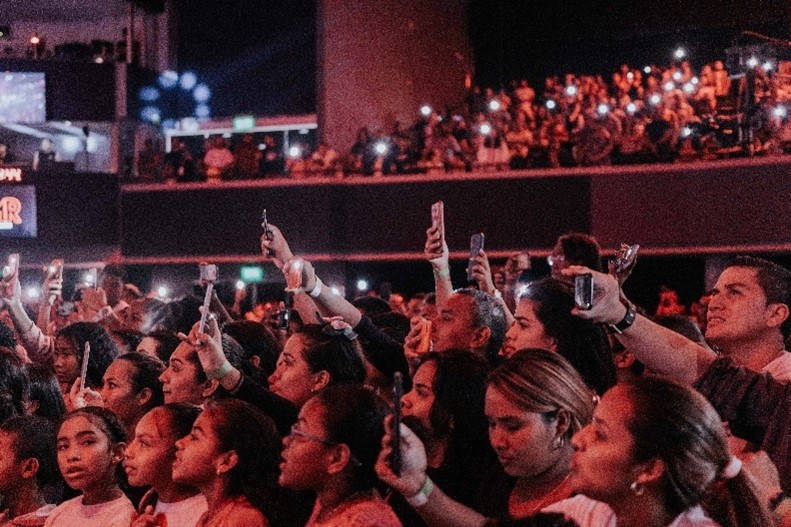
One of the most striking aspects of the documentary is the strong sense of connection between the fans. Together, they appear to contribute positively to both the atmosphere and the safe progression of the event.
This fits well with social identity theory, which has frequently been discussed in relation to crowd behaviour by psychologists such as John Drury. Crowds with a strong shared social identity are generally more likely to consider one another, support each other and offer help when someone is in difficulty. The shared purpose of attending the concert and being part of the same collective experience can have a significant influence on individual and collective behaviour.
Over the two days, there were reportedly only 10 arrests among 250,000 visitors and around 7,000 backstage VIPs. Given the number of people present, this is remarkably low. Perhaps Oasis fans were exceptionally well behaved… or simply very discreet.
Text continues below the image.
Show Stops
Of course, the enormous fan base of the Britpop rock band also brought significant crowd risks. From 1997 onwards, Oasis began working with a show-stop procedure. During an earlier performance in Aberdeen, the energy of the audience had become so intense that an action plan was developed in case an accident or dangerous situation occurred in the future.
The Gallagher brothers would be informed whenever crowd safety was at risk. Over the years, Oasis stopped or temporarily paused between 17 and 25 shows around the world for safety reasons. The band fully supported these measures, as they wanted to prevent accidents from occurring during their concerts and nobody can influence a show and redirect the energy of a crowd in the same way as their idol can.
Text continues below the video.
A Social Identity That Remains Strong
Oasis split up in 2009, but the band had already sold more than 70 million records worldwide and achieved eight UK number-one singles and eight UK number-one albums.
Even after the band’s split, being an Oasis fan and sharing a connection to their music appears to have continued to provide fans with a collective identity and shared purpose. After 16 years, the patience of loyal fans was rewarded when the band reunited for a tour in 2025.
Sources: RadioX (2022), BBC (2016), The Sun (2021), The Guardian (2022)
The Knebworth concerts were documented in the film: Oasis Knebworth 1996.